
Gitalchemy vs LabCoat: Which GitLab Android App Wins?
This article is part of our Top GitLab Android Clients comparison series.
Gitalchemy vs LabCoat: Which GitLab Android App Wins?
LabCoat is the veteran of GitLab clients on Android, with more than 100,000 downloads on Google Play and an Apache 2.0 licence. It is also still maintained: version 3.0.4 shipped in April 2026, and the app reached the App Store on 9 April 2026, so it now covers Android and iOS.
Verdict: if you want the full review workflow, and pipelines you can act on, Gitalchemy is the better app. If you want a familiar, widely installed Android and iOS client for browsing projects, reading commits and commenting, LabCoat is a reasonable and well proven choice.
LabCoat's maintenance status, with dates
It is worth correcting a claim that has spread in 2026 comparison posts: LabCoat has not been abandoned.
| Release | Date |
|---|---|
| 2.7.9 | April 2024 |
| 2.8.0 | October 2025 |
| 3.0.0 to 3.0.4 | April 2026 |
| F-Droid build 2.8.0 (published after the upstream tag) | March 2026 |
| App Store release, iOS | 9 April 2026 |
So the honest summary is not "unmaintained", it is "bursty". Between April 2024 and October 2025 the project went roughly eighteen months without a release, and then it shipped five versions inside a month in April 2026 as the app moved to Compose Multiplatform and picked up an iOS target. Google Play shows the listing updated on 16 April 2026.
If you are picking a client to depend on, the question is not only whether a release exists but how often one arrives. LabCoat has been through a long quiet period once already.
Gitalchemy for GitLab on Android
Gitalchemy is a native GitLab client for Android, built with Tauri v2, React and TypeScript and licensed MIT. It is on F-Droid, so you can install and update it without a Google account.
Pros:
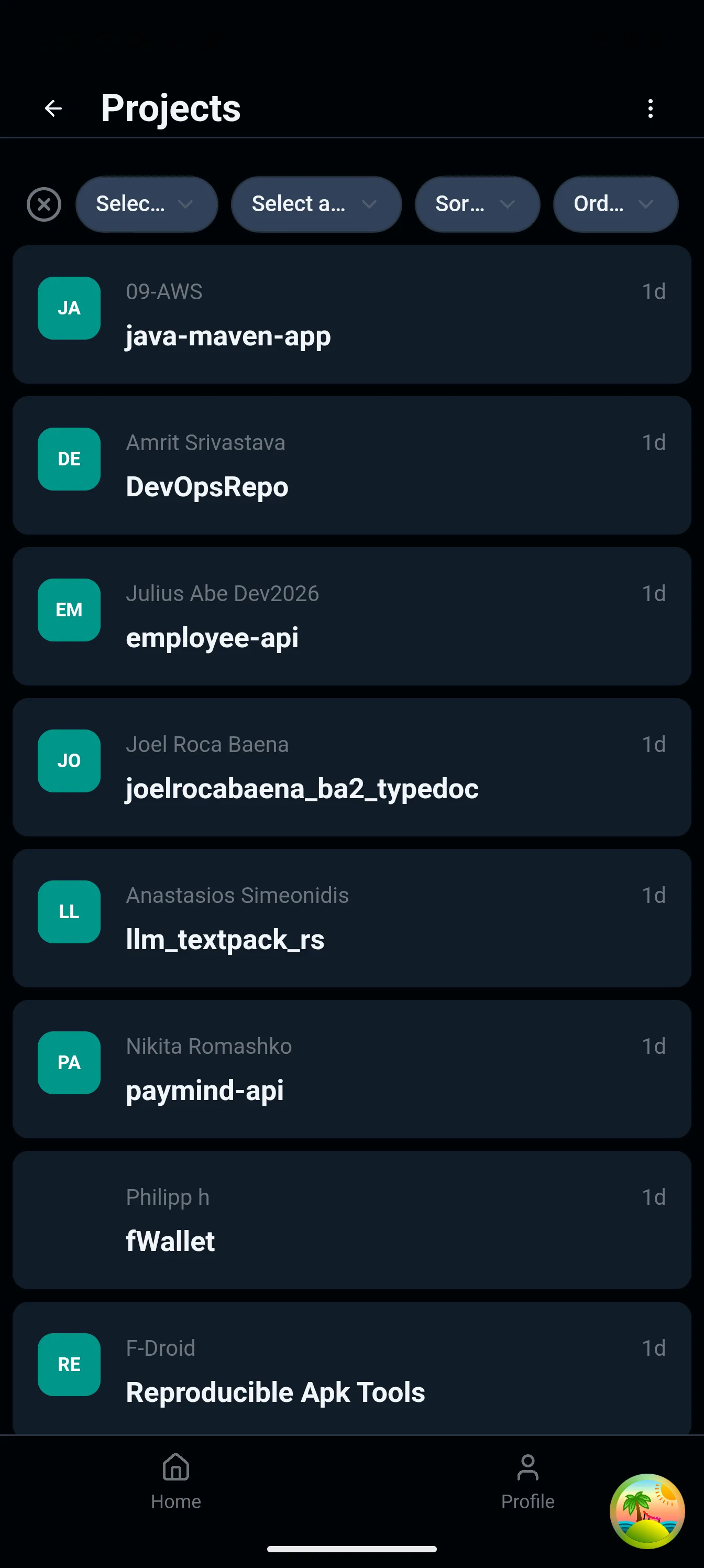
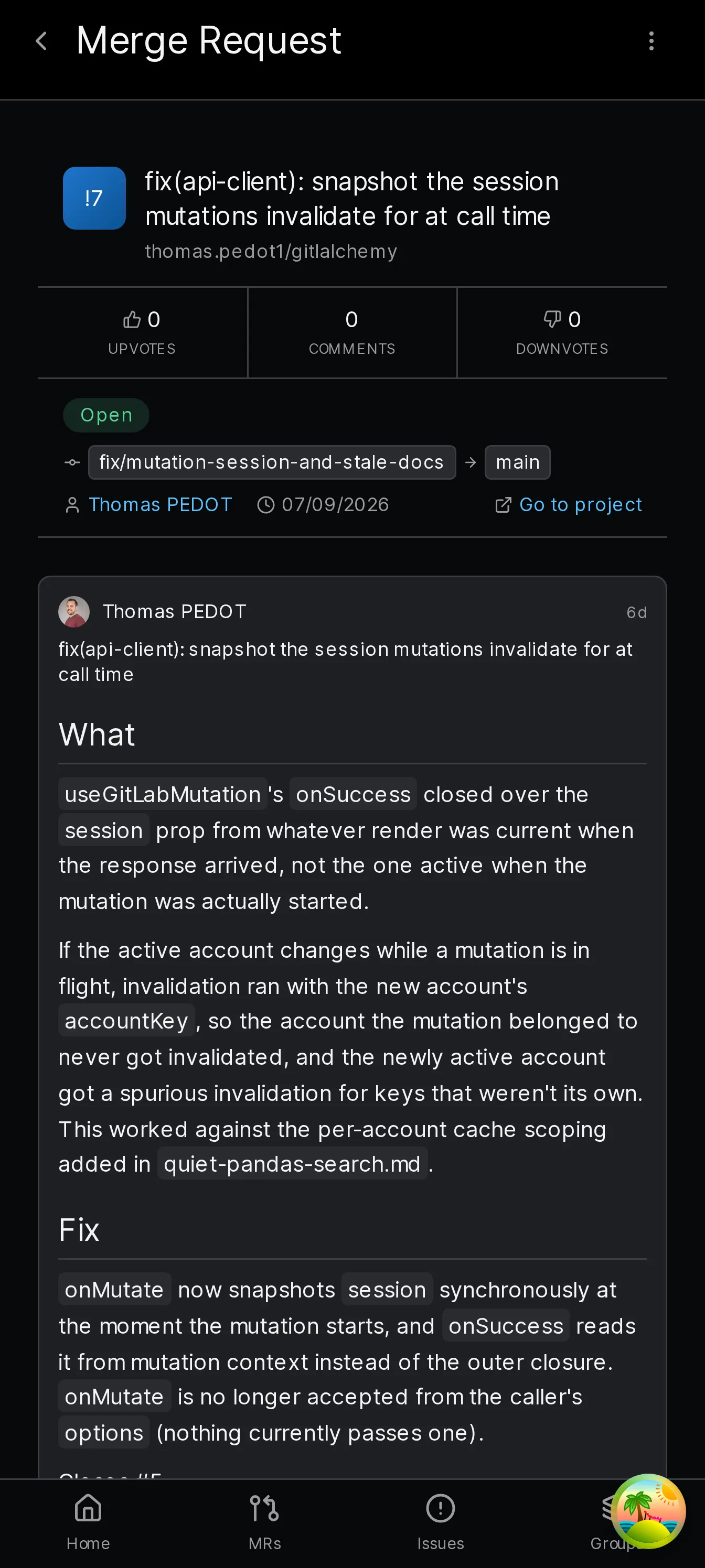
- Merge request review that fits a phone. Read the diff in the Changes tab, comment on individual lines, hold your comments as drafts with Start review, and submit them as one review. Changes, Commits and Pipelines tabs sit next to each other.
- Merge readiness with actions. Approve, rebase or merge from the same panel, with the coverage figure and artifacts download alongside.
- Pipelines you operate, not just watch. Jobs grouped by stage, with Retry, Cancel, Play for a manual job and Download artifacts, plus scope tabs and a filter on the list.
- Issue editing. Assignees, labels, milestones, due dates, estimates and spent time are editable, labels render as coloured chips, and comments support attachments and internal notes.
- A repository tree with a file filter. Plus the README below the code card, the active branch's last commit and a browsable tag list.
- No Google services in the notification path. Notifications come from polling the GitLab Todos API and are delivered by the operating system.
Cons:
- Newer and smaller. LabCoat's user base is an order of magnitude larger.
- No biometric lock. If a fingerprint gate on the app itself is a requirement, LabCoat's sibling LabNex has one and Gitalchemy does not.
LabCoat
LabCoat has been on Android since the early days of GitLab's API and is still one of the most installed GitLab clients anywhere. The source, the issue tracker and the changelog are at gitlab.com/Commit451/LabCoat.
Pros:
- A large, long established user base. More than 100,000 downloads on Google Play, with a 3.8 star average across roughly 1.36K reviews.
- Open source under Apache 2.0. The whole application is auditable and forkable.
- Broad, traditional coverage. View commits, browse and view files, view, edit and close issues, comment on issues and merge requests, and manage groups and project members.
- Two platforms, and now two stores. It is on F-Droid and Google Play for Android, and on the App Store for iOS 16 and later since April 2026.
- It keeps up with GitLab. The April 2026 releases were spent modernising the app rather than fixing it into place.
Cons:
- Review stops at commenting. There is no draft review flow, no merge readiness panel and no pipeline actions, so approving and merging means leaving the app or working around it.
- File browsing complaints. The file tab has drawn reports of missing files for years, most recently a reviewer in July 2026 reporting crashes while browsing project files. Treat single reviews as anecdotes, but the file browser is the part of the app users complain about.
- Network dependent. LabCoat is an online client; on a bad connection the app has less to show you.
Head to head
| Feature | Gitalchemy | LabCoat |
|---|---|---|
| Platforms | Android | Android and iOS |
| On F-Droid | Yes | Yes |
| Licence | MIT | Apache 2.0 |
| Latest release | 1.4.0, September 2026 | 3.0.4, April 2026 |
| Diff review with line comments | Yes | Commenting on the merge request |
| Draft review with Start review | Yes | No |
| Merge readiness, approve, rebase, merge | Yes | Not offered |
| Pipeline actions (retry, cancel, manual job, artifacts) | Yes | Not offered |
| Issue editing with labels, milestones, dates | Yes | Yes |
| Biometric lock | Not offered | Not documented |
| Price | Free | Free |
Which should you install?
Choose Gitalchemy if the phone is where you actually review code. The review flow and the pipeline actions are the two things LabCoat does not have, and they are the two things that decide whether you can finish a review without opening a laptop.
Choose LabCoat if you want the most widely used GitLab client on Android, you value that it now covers iPhone as well, and your GitLab work on a phone is mostly reading: commits, files, issues and comments. It is a solid app with a long history, and the April 2026 releases show the project is alive.
Either way, both are open source and both are on F-Droid, which is the cleanest way to install a GitLab client on Android. If you are weighing more options, the Android client comparison covers LabNex, Lab+ and Nitro, and the LabNex comparison goes deeper on the strongest open source alternative.
Related Articles
More from Comparisons
Take GitLab with you
Gitalchemy is free and open source. Install it on Android from F-Droid.
Questions, or want to follow the work? Reach us at contact@gitalchemy.com or star the project on GitLab.