
Gitalchemy vs LabNex: Which GitLab Android Client to Use
This article is part of our Top GitLab Android Clients comparison series.
Gitalchemy vs LabNex: Which GitLab Android Client to Use
Verdict: Gitalchemy is the better choice if you want deeper merge request review, and pipelines you can act on. LabNex is the better choice if you want a fully open source Android client with active development on Codeberg and you do not need merge request review.
Both are genuinely good apps, both are open source, and both are on F-Droid. The differences are in depth and in where the projects live, so this page compares them on the work you actually do on a phone.
Where LabNex lives now
LabNex development moved to Codeberg. The GitHub repository was archived on 17 June 2026 and left in read-only mode, so the source, the issue tracker and the wiki you want are at codeberg.org/labnex/LabNex. The F-Droid build (com.labnex.app) is current, and the project is still maintained.
That matters if you pick a client based on where its community is. Any guide that still points at the GitHub repository is pointing at an archive.
Gitalchemy
Gitalchemy is a native GitLab client for Android, built with Tauri v2, React and TypeScript, and licensed MIT.
Pros:
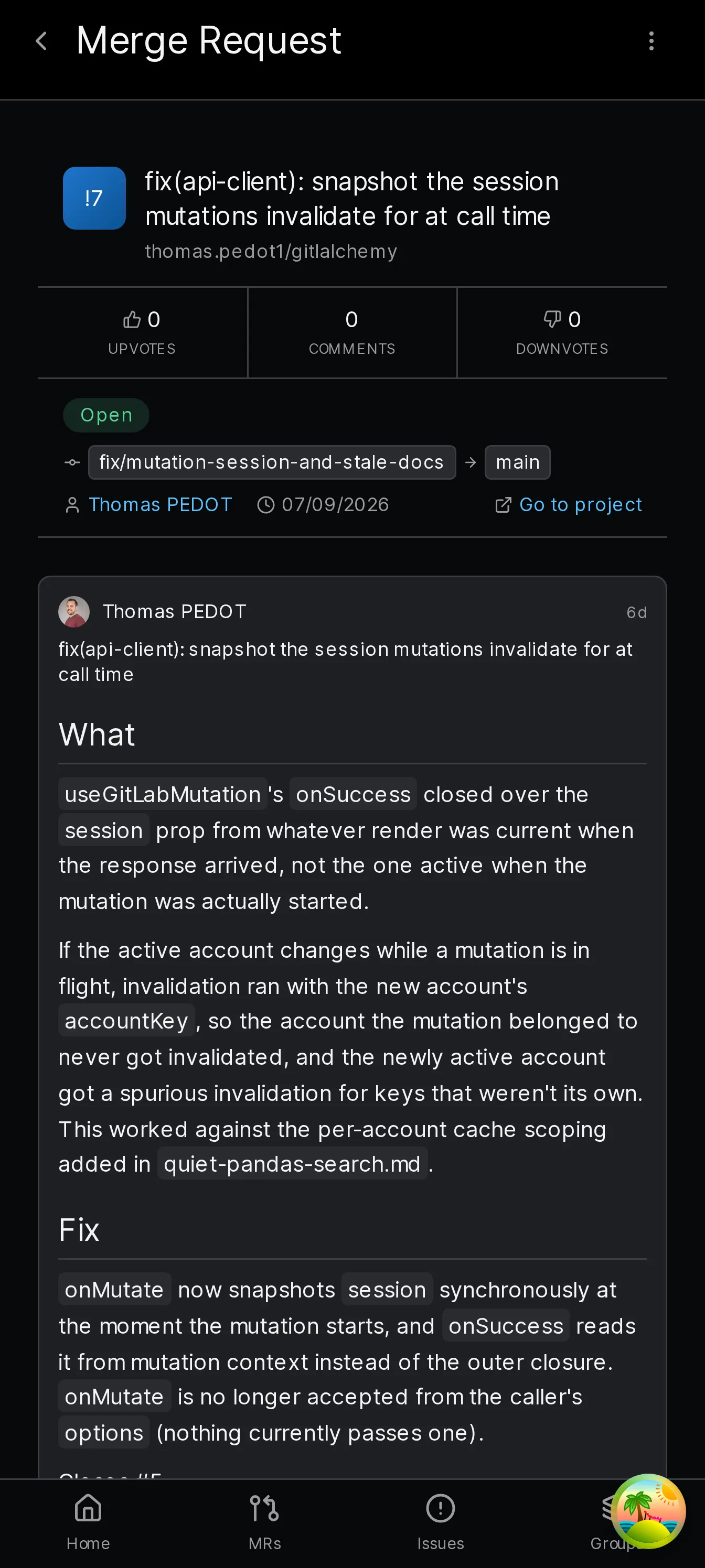
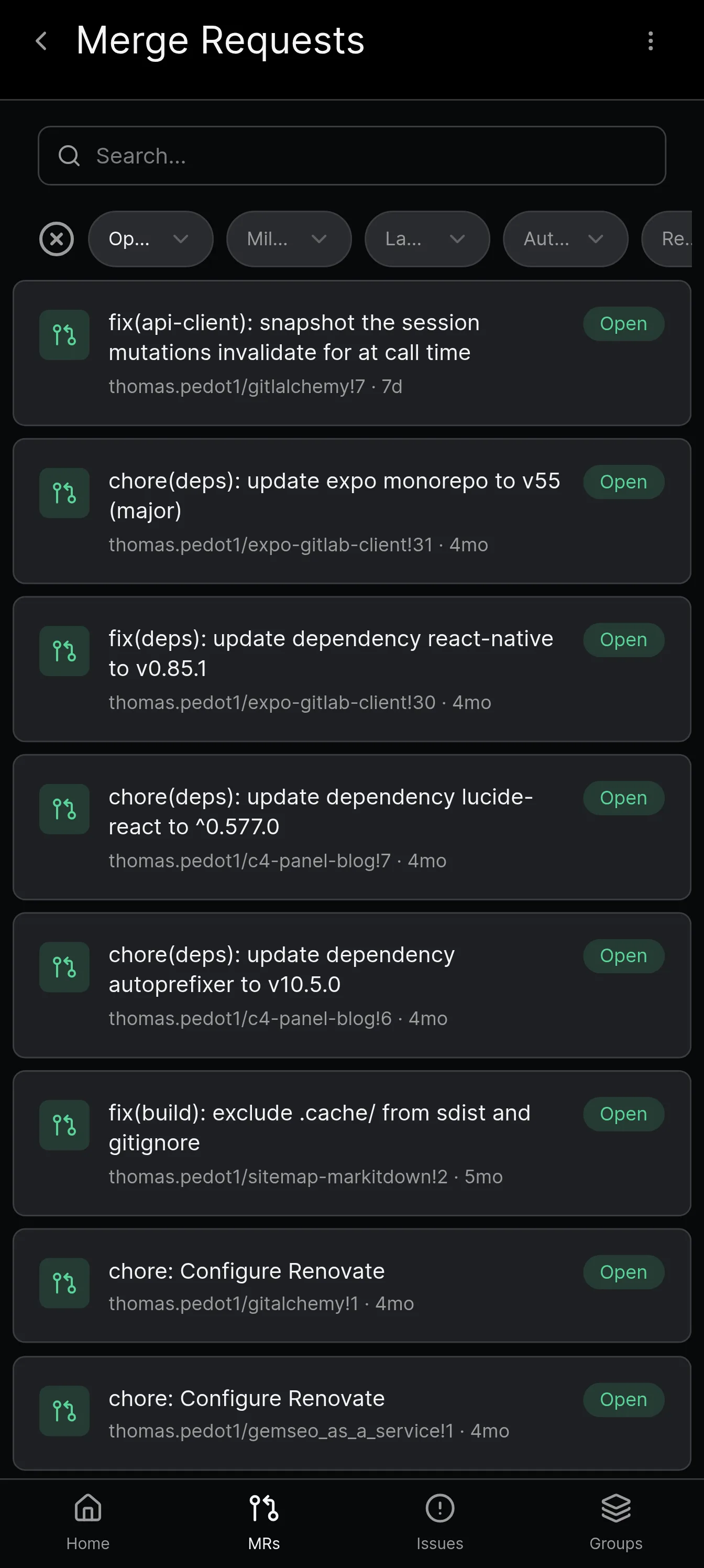
- Merge request review that goes somewhere. Merge readiness with approve, rebase and merge, Changes, Commits and Pipelines tabs with inline pipeline status, a Start review flow that holds draft comments until you submit them, coverage information and artifacts download.
- Actionable pipelines. Jobs grouped by stage with Retry, Cancel, Play for a manual job and Download artifacts, plus scope tabs and a filter on the pipeline list.
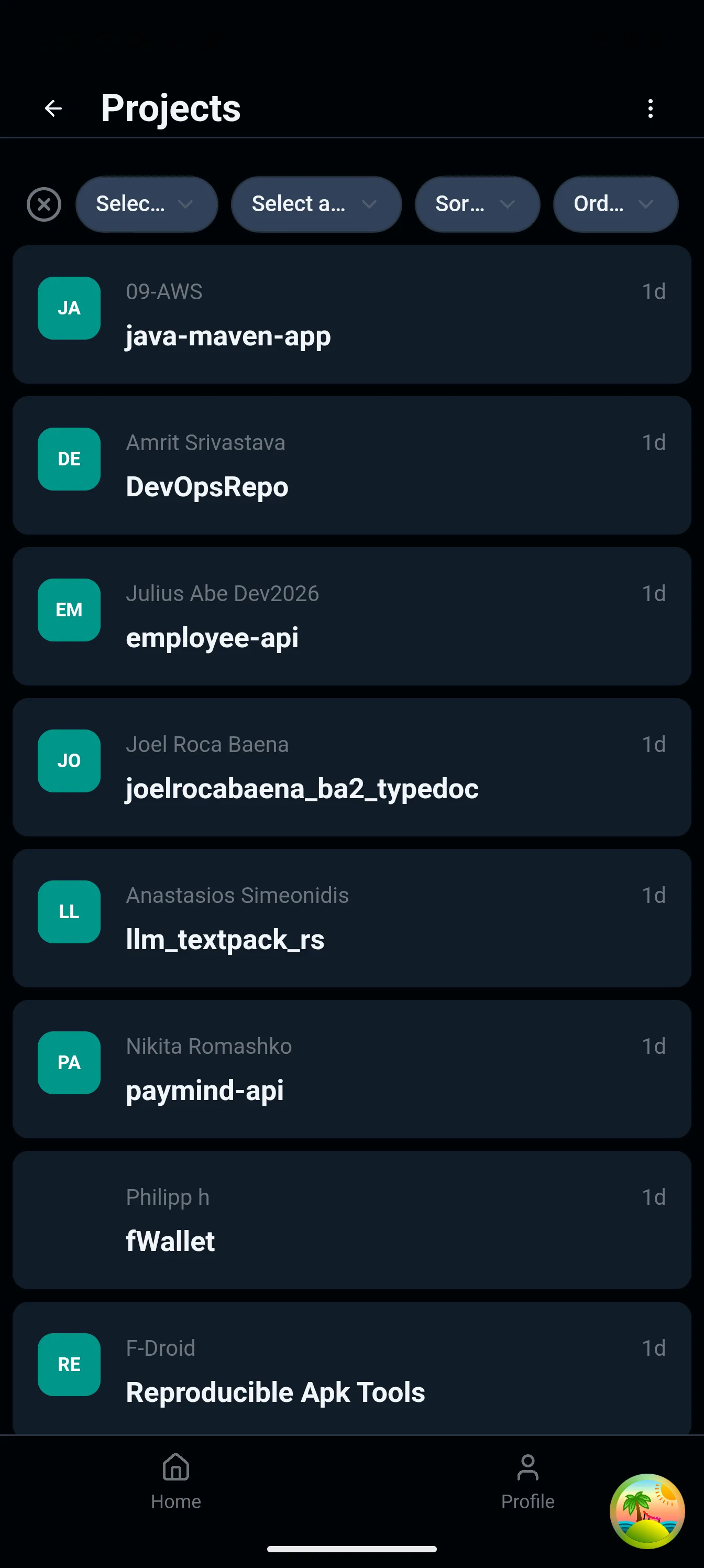
- Repository browsing built for small screens. A repository tree with a Find file filter, the README below the code card, the active branch's last commit and a browsable tag list.
- Issue editing, not just reading. Assignees, labels, milestones, due dates, estimates and spent time are editable, labels render as coloured chips, and comments support attachments and internal notes.
- Self-hosted friendly. API requests are issued from Rust rather than the web view, which is what lets the app sign in to instances behind a proof of work gate, and images served by your instance are fetched with your token so they render.
- No Google services in the notification path. Notifications come from polling the GitLab Todos API and are delivered by the operating system.
Cons:
- A smaller project. Fewer users than the older clients, so less community material to search when something goes wrong.
LabNex
LabNex is an open source GitLab client for Android, licensed GPLv3, available on both F-Droid and Google Play (the Play version is the paid premium build).
Pros:
- Multiple accounts and self-hosted instances. You can add as many GitLab instances as you need and switch between them, which is the feature its users tend to lead with.
- A broad feature list. Projects and groups, issues, merge requests and commits, releases, milestones and wikis, a Markdown code editor and a diff viewer.
- Biometric lock. App level biometric protection, which the other clients here do not offer.
- Material Design 3, refreshed. Version 8.0.0 shipped a redesigned interface built on M3 expressive design.
- Self-signed certificates. Documented support, which matters on internal instances with a private CA.
Cons:
- A paid build on Google Play. The Play listing is the premium version, priced at 5.99 USD when checked, while the F-Droid build is free. Check which one you are installing.
- Shallower merge request and pipeline work. Merge requests are readable and commentable, but there is no review flow that holds draft comments, no merge readiness panel, and pipelines are watched more than operated.
- One fewer distribution channel than you might expect. The GitHub mirror is an archive now, so Codeberg is the only place development happens.
Head to head
| Feature | Gitalchemy | LabNex |
|---|---|---|
| Platforms | Android | Android |
| On F-Droid | Yes | Yes |
| Licence | MIT | GPLv3 |
| Merge request review flow | Changes, Commits and Pipelines tabs, Start review with draft comments | Viewing and commenting |
| Merge readiness, approve, rebase, merge | Yes | Not available |
| Pipeline actions (retry, cancel, manual job, artifacts) | Yes | Read oriented |
| Repository tree with file filter | Yes | File browser |
| Issue editing (assignees, labels, milestones, dates) | Yes | Yes |
| Multiple accounts | Yes, with a separate cache per account | Yes |
| Biometric lock | Not offered | Yes |
| Self-signed certificates | Not documented | Documented support |
| Source and issues | gitlab.com/thomas.pedot1/gitlalchemy | codeberg.org/labnex/LabNex |
| Price | Free | Free on F-Droid, paid on Google Play |
Which one should you pick?
Pick Gitalchemy if the phone is where you review code, approve merge requests and unblock pipelines. The merge request flow is the thing LabNex does not offer and cannot easily add.
Pick LabNex if you want a purely Android, fully open source client, you value the biometric lock and the breadth of its project features, and you are comfortable that merge request review stays closer to reading than to reviewing.
Either way, install from F-Droid where you can: it keeps updates independent of your Google account, and both projects publish there. If you are still weighing the wider field, the Android client comparison covers LabCoat, Lab+ and Nitro as well.
Related Articles
More from Comparisons
Take GitLab with you
Gitalchemy is free and open source. Install it on Android from F-Droid.
Questions, or want to follow the work? Reach us at contact@gitalchemy.com or star the project on GitLab.